
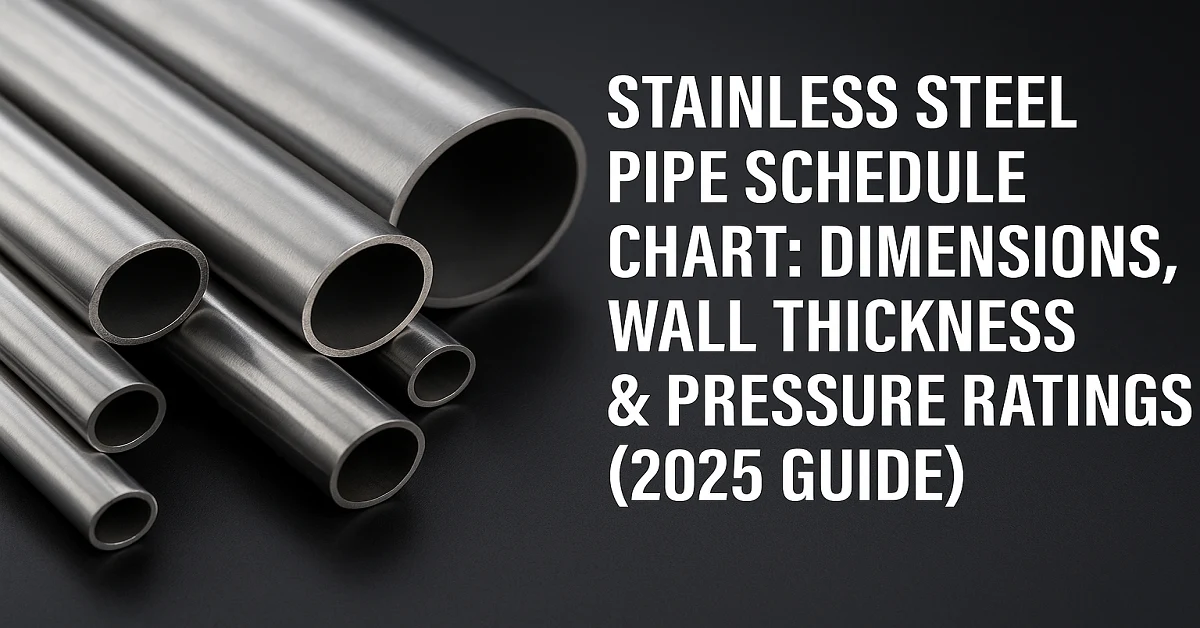
The stainless steel pipe schedule chart defines how thick or strong a pipe is relative to its diameter. These charts are critical for selecting pipes in high-pressure, high-temperature, and structural applications.
In this 2025 guide, we explain pipe schedules (SCH 5 to SCH 160), provide a dimension chart, list pressure ratings, and answer frequently asked questions about SS pipe schedules according to ASTM, ASME, and ANSI standards.
What Is a Stainless Steel Pipe Schedule?
A pipe schedule refers to the standardized wall thickness of a pipe. It determines how much pressure the pipe can safely handle.
The schedule number (SCH) increases with wall thickness — meaning SCH 80 pipes are thicker (and stronger) than SCH 40 pipes of the same nominal size.
The schedule system was introduced by ANSI B36.19M and ASME B36.10M to unify industrial manufacturing and ensure compatibility across fittings, flanges, and valves.
Understanding Stainless Steel Pipe Schedule Numbers
| Schedule No. (SCH) | Relative Wall Thickness | Common Use |
|---|---|---|
| SCH 5 | Thin wall | Low-pressure, HVAC, decorative |
| SCH 10 | Light wall | General industrial piping |
| SCH 20 | Medium wall | Moderate pressure systems |
| SCH 40 | Standard wall | Plumbing, construction |
| SCH 80 | Extra strong | High-pressure pipelines |
| SCH 160 | XXS (Double Extra Strong) | Ultra-high pressure, heavy-duty |
Stainless Steel Pipe Schedule Chart (in mm and inches)
1. Common Pipe Sizes — ASTM A312 (Stainless Steel Seamless/Welded Pipes)
| Nominal Pipe Size (NPS) | Outside Diameter (OD) | SCH 10 (mm) | SCH 40 (mm) | SCH 80 (mm) |
|---|---|---|---|---|
| ½” | 21.3 mm | 2.11 | 2.77 | 3.73 |
| ¾” | 26.7 mm | 2.11 | 2.87 | 3.91 |
| 1” | 33.4 mm | 2.77 | 3.38 | 4.55 |
| 1¼” | 42.2 mm | 2.77 | 3.56 | 4.85 |
| 1½” | 48.3 mm | 2.77 | 3.68 | 5.08 |
| 2” | 60.3 mm | 2.77 | 3.91 | 5.54 |
| 2½” | 73.0 mm | 3.05 | 5.16 | 7.01 |
| 3” | 88.9 mm | 3.05 | 5.49 | 7.62 |
| 4” | 114.3 mm | 3.05 | 6.02 | 8.56 |
| 6” | 168.3 mm | 3.05 | 7.11 | 10.97 |
| 8” | 219.1 mm | 3.05 | 8.18 | 12.70 |
| 10” | 273.1 mm | 3.40 | 9.27 | 12.70 |
| 12” | 323.9 mm | 3.96 | 10.31 | 14.27 |
Reference: ASTM A312 / A358 / ANSI B36.19M
Pipe Schedule vs. Pressure Rating
The pressure a pipe can withstand depends on three main factors:
- Wall Thickness (Schedule)
- Pipe Diameter (OD)
- Material Strength (Yield Stress)
Approximate Pressure Ratings for SS 304 Pipes (at 38°C)
| Nominal Pipe Size (inches) | SCH 10 (Bar) | SCH 40 (Bar) | SCH 80 (Bar) |
|---|---|---|---|
| 1” | 65 | 100 | 160 |
| 2” | 55 | 85 | 130 |
| 3” | 45 | 75 | 120 |
| 4” | 35 | 60 | 100 |
| 6” | 25 | 45 | 75 |
(Values are approximate and vary with material grade and temperature.)
Pipe Schedule Thickness Conversion Formula
To determine schedule from wall thickness:
Schedule (SCH) = (1000 × P) / (S × (OD – t))
Where:
- P = Internal pressure (MPa)
- S = Allowable stress (MPa)
- OD = Outer diameter (mm)
- t = Wall thickness (mm)
Example:
For a 2” SS 304 pipe with 3.91mm thickness, allowable stress of 138MPa, and 10 Bar pressure, the calculated schedule is close to SCH 40.
Common Grades Used in Stainless Steel Pipes
| Grade | Material Type | Applications |
|---|---|---|
| SS 304 / 304L | Austenitic | Plumbing, food-grade use |
| SS 316 / 316L | Marine, corrosion resistant | Chemical plants, offshore |
| SS 310 | Heat-resistant | Boilers, furnaces |
| SS 321 | Stabilized for welding | Exhaust, turbine |
| SS 347 | High temperature | Petrochemical |
How to Choose the Right Schedule for Your Project
Determine the operating pressure and temperature.
Select material grade (e.g., SS 304, 316L).
Refer to the schedule chart to match OD and thickness.
Verify pressure ratings with design codes like ASME B31.3.
Choose compatible fittings and flanges (same schedule).
Real-World Industry Usage
| Industry | Typical Schedule Used | Reason |
|---|---|---|
| Plumbing & Sanitation | SCH 10 / SCH 20 | Low pressure |
| Industrial Piping | SCH 40 | Standard strength |
| Chemical & Pharma | SCH 80 | High pressure & corrosion resistance |
| Power Plants | SCH 160 | Extreme pressure & temperature |
| Marine Industry | SCH 80 | Saltwater corrosion resistance |
Outbound link suggestion: World Steel Association
Common Mistakes to Avoid
Mixing schedules: Fittings and flanges must match the pipe schedule.
Ignoring temperature derating: Higher temperatures lower pressure tolerance.
Wrong material assumption: SS 304 and SS 316 differ significantly under stress.
Industry Quote
“For engineers, knowing the difference between Schedule 10 and Schedule 80 can mean the difference between system safety and catastrophic failure.”
— A. Mehra, Senior Engineer, Indian Institute of Welding
Frequently Asked Questions (FAQ)
Q1: What is a pipe schedule in simple terms?
It’s a numerical system that defines wall thickness and pressure capacity of a pipe.
Q2: What is the most common stainless steel pipe schedule?
SCH 40 — used in 70% of general piping applications.
Q3: What is the difference between SCH 40 and SCH 80?
SCH 80 pipes have thicker walls and higher pressure ratings than SCH 40.
Q4: Which schedule is best for high-pressure use?
SCH 80 or SCH 160, depending on design requirements.
Q5: Does the same schedule apply to all materials?
The numbering is consistent, but actual thickness varies slightly based on material type and manufacturing standards.
Conclusion
The stainless steel pipe schedule chart is the foundation for proper pipe selection in any industrial or structural project.
By understanding NPS, OD, wall thickness, and pressure ratings, you can choose the right schedule for your needs — ensuring safety, compliance, and performance.
In 2025, as industries shift toward high-efficiency stainless steel systems, using standard schedules such as SCH 40, SCH 80, and SCH 160 remains the best practice for reliability and design consistency.