
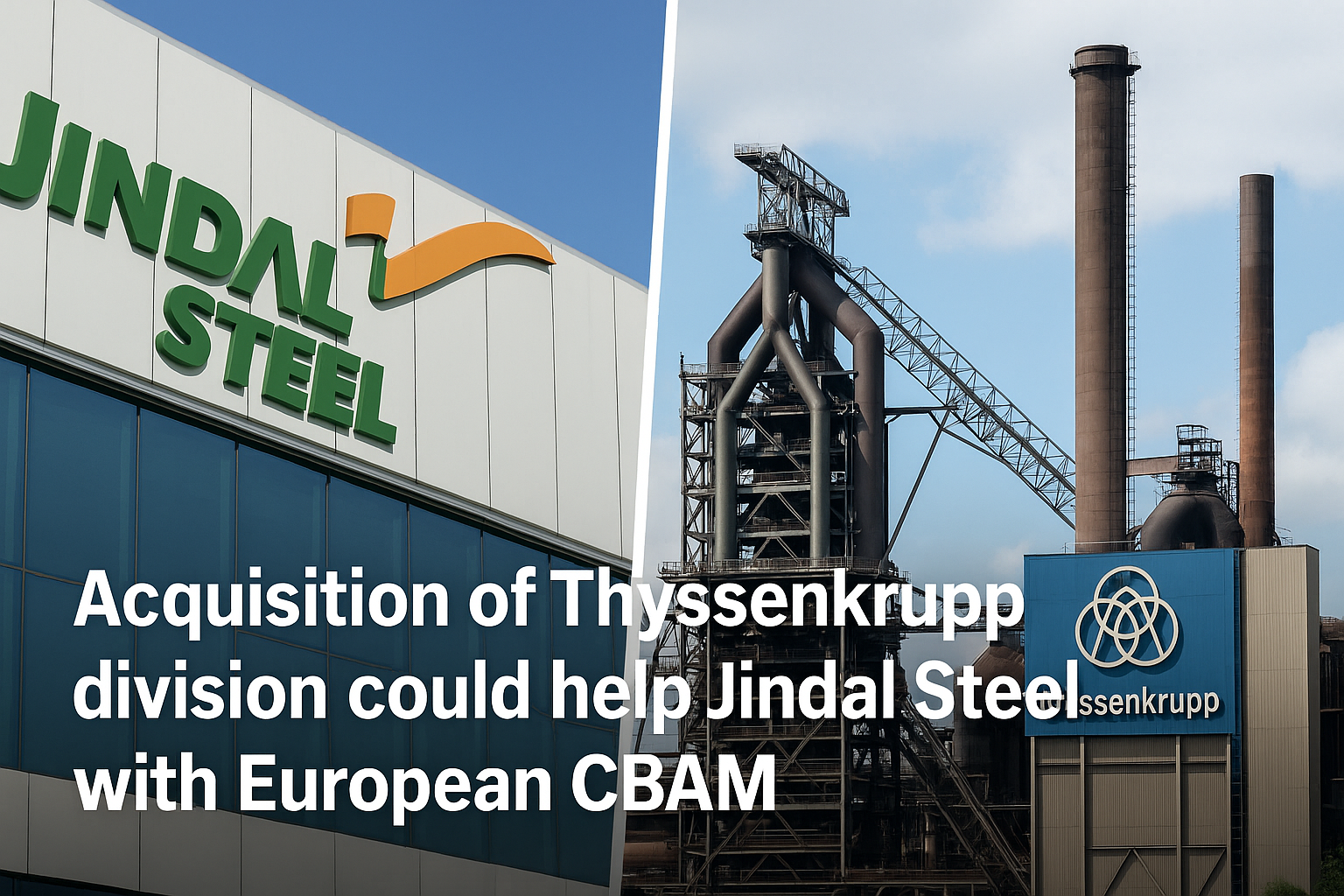
Jindal Steel & Power (JSPL) is exploring the acquisition of a Thyssenkrupp steel division in Europe, a move that could help the company navigate the EU’s Carbon Border Adjustment Mechanism (CBAM).
With CBAM fully phasing in by 2026, Indian steelmakers exporting to Europe will face new carbon-related levies. By acquiring local assets, Jindal Steel can strengthen its European presence, reduce tariff exposure, and gain access to cleaner technologies.
Introduction: Jindal Steel, Thyssenkrupp, and CBAM
The acquisition of Thyssenkrupp division by Jindal Steel could be a strategic game-changer. With the European Union implementing the Carbon Border Adjustment Mechanism (CBAM), steel companies exporting to Europe must pay higher costs for carbon-intensive production.
By owning European assets, Jindal Steel can partially bypass these levies, integrate into the EU value chain, and demonstrate commitment to low-carbon steelmaking. This comes at a time when India’s steel exports to the EU are valued at nearly $2.5 billion annually.
What is the EU’s CBAM?
The Carbon Border Adjustment Mechanism is a policy by the European Union to tax imports of carbon-intensive goods such as steel, aluminum, cement, fertilizers, and electricity.
- CBAM entered its transitional phase in 2023.
- By January 2026, importers must purchase CBAM certificates reflecting carbon costs.
- Steel is one of the most impacted sectors.
This means Indian exporters with higher carbon footprints could face tariffs of €80–100 per tonne, making exports less competitive.
Outbound link suggestion: European Commission – CBAM
Why Thyssenkrupp Assets Matter for Jindal Steel
- Local Production Advantage
Owning a European facility reduces CBAM exposure since production inside the EU follows the Emissions Trading System (ETS) instead of border tariffs. - Technology Transfer
Thyssenkrupp has been developing hydrogen-based steelmaking through its “tkH2Steel” project, which could help Jindal adopt cleaner processes. - Market Access
Acquisition improves Jindal Steel’s footprint in the EU, which consumes over 140 million tonnes of steel annually.
Financial and Strategic Considerations
- Thyssenkrupp’s steel division has faced restructuring pressure, with assets valued around €3–4 billion.
- Jindal Steel, with a market cap of over ₹1.2 lakh crore, is well-positioned financially.
- Analysts believe the acquisition could be funded through a mix of debt and equity, with synergies offsetting CBAM-related costs.
Image suggestion: Stock market ticker showing Jindal Steel shares rising
Alt text: Jindal Steel stock performance linked to Thyssenkrupp acquisition and CBAM strategy
Caption: Markets expect Jindal Steel to benefit strategically from an EU acquisition.
How CBAM Affects Indian Steelmakers
- India exported nearly 6.7 million tonnes of steel to the EU in FY25.
- CBAM could increase costs by 10–15%, eroding competitiveness.
- Companies like Tata Steel (with European operations) are better shielded, while JSPL and SAIL face bigger risks.
Internal link suggestion: Read our article: India Steel Consumption FY26: Growth to Reach 9-10% Says Steel Secretary
Industry Expert Quotes
- “Jindal Steel’s acquisition of Thyssenkrupp assets would be a smart hedge against CBAM risks.” — Senior Analyst, CRISIL
- “Hydrogen-based steel projects in Europe are the future. Indian companies need exposure to stay competitive globally.” — Economist, World Steel Association
Risks and Challenges
- Integration Risks: Managing operations across geographies.
- High Costs: Acquisition and modernization expenses.
- Policy Uncertainty: Changes in EU climate policy could impact investment logic.
Global Context
- China is also investing in green steel to counter CBAM.
- Japan and Korea are exploring bilateral carbon agreements with the EU.
- Indian policymakers are negotiating with Brussels for CBAM concessions.
Frequently Asked Questions (FAQ)
Q1: What is CBAM and why does it matter for Indian steel exporters?
It is the EU’s carbon tax on imports, which raises costs for carbon-intensive products like steel.
Q2: How would acquiring Thyssenkrupp help Jindal Steel?
It would reduce CBAM tariffs, improve EU access, and bring advanced green steel technology.
Q3: When does CBAM fully apply?
From January 2026, with mandatory certificate purchases.
Q4: Which Indian steelmakers are most exposed?
SAIL and JSPL, since they lack significant EU-based operations.
Q5: What are the financial implications of this deal?
It could cost €3–4 billion but provide long-term savings by avoiding CBAM costs.
Conclusion
The acquisition of Thyssenkrupp division by Jindal Steel could be a landmark move for India’s steel industry. With the EU’s CBAM reshaping trade flows, this acquisition would provide strategic protection, advanced technology, and stronger market access.
As the CBAM deadline nears, Jindal’s move could set a precedent for other Indian steelmakers exploring overseas acquisitions to remain competitive.