
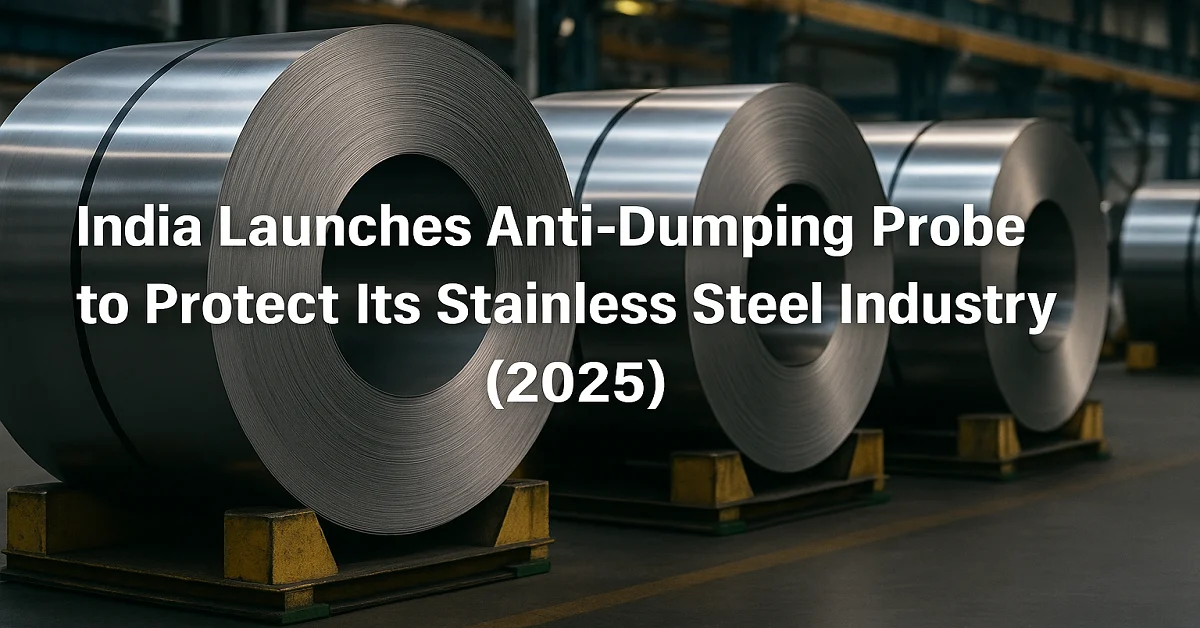
India Steps In to Protect Its Steel Backbone
India’s Ministry of Commerce and Industry has launched a major anti-dumping investigation into stainless steel imports from China, Indonesia, and Vietnam, following complaints from domestic producers about unfair pricing.
This probe — initiated by the Directorate General of Trade Remedies (DGTR) — marks a critical moment for India’s stainless steel industry, which faces growing pressure from low-cost imports that threaten local manufacturing and employment.
The move reflects India’s broader commitment to trade fairness, industrial protection, and self-reliance under the “Make in India” initiative.
What Is Dumping and Why Is It Harmful?
“Dumping” occurs when a country exports goods at prices lower than their normal value — often below production cost — to gain unfair market share abroad.
In the case of stainless steel, dumped imports undercut local prices, leaving Indian producers struggling to compete despite higher quality and compliance with global standards.
According to DGTR data, India imported over 500,000 tonnes of stainless steel in FY2024, a sharp increase from 370,000 tonnes in FY2021. Most of this surge came from China and Indonesia, known for large state-backed steel capacity and export incentives.
“Unchecked dumping is eroding India’s industrial foundation,” said a senior executive at Jindal Stainless. “We need a level playing field, not artificial price wars.”
Why Is the Stainless Steel Industry Important to India?
India is the second-largest producer of stainless steel in the world, after China, with an annual capacity exceeding 6 million tonnes. The industry employs over 2 million people directly and indirectly.
Stainless steel is essential in sectors such as:
- Construction and infrastructure
- Railways and metro systems
- Food processing and kitchenware
- Automotive and energy
Despite this strong base, Indian producers operate at only 65–70% capacity utilization, largely because of underpriced imports and volatile nickel costs.
Countries Under Investigation
The DGTR probe focuses on stainless steel flat products imported from:
- China – Major exporter of low-cost cold-rolled stainless steel sheets.
- Indonesia – Rapidly growing supplier with nickel-rich smelting facilities.
- Vietnam – Emerging player with export-linked subsidies.
Together, these countries account for more than 80% of India’s stainless steel imports, much of which is priced 15–30% lower than domestic equivalents.
Which Companies Filed the Complaint?
The petition was jointly filed by:
- Jindal Stainless Limited (JSL)
- Jindal Stainless (Hisar) Limited
These are India’s largest stainless steel manufacturers, representing a combined production capacity of over 2.9 million tonnes per year.
They allege that aggressive underpricing by foreign exporters has led to:
- Price depression in the domestic market
- Idle capacity in Indian mills
- Job cuts in manufacturing units across Haryana, Odisha, and Gujarat
DGTR’s Role and Process
The Directorate General of Trade Remedies (DGTR) functions under India’s Ministry of Commerce and investigates cases of dumping, subsidies, or sudden import surges that harm local industries.
Once a petition is accepted:
- DGTR issues a notice of initiation to all stakeholders.
- Exporters, importers, and domestic producers must submit evidence.
- The authority conducts on-site verifications, pricing analyses, and market impact studies.
- A preliminary determination may be made within 90 days, followed by final findings within 6–12 months.
If dumping is proven, anti-dumping duties can be imposed for up to five years.
What Products Are Covered?
The investigation targets stainless steel flat-rolled products, including:
- Hot-rolled sheets and coils
- Cold-rolled sheets and coils
- Plates and strips
Excluded are specialized grades like automotive stainless steel and precision tubing.
According to DGTR, these are the categories where dumping margins are “most significant and injurious.”
Market Impact: The Numbers Speak
India’s stainless steel consumption stands at ~4 million tonnes annually, growing at 6–7% per year. However, the market share of imported products jumped from 12% in 2019 to nearly 28% in 2024, squeezing local players.
| Year | Imports (Tonnes) | Domestic Production (Tonnes) | Import Share (%) |
|---|---|---|---|
| 2019 | 280,000 | 3.2 million | 12% |
| 2021 | 370,000 | 3.4 million | 17% |
| 2024 | 500,000 | 3.5 million | 28% |
(Source: DGTR & Indian Stainless Steel Development Association – ISSDA)
Real-World Impact on Indian Companies
Jindal Stainless, India’s largest producer, reported a 20% drop in domestic sales between 2022 and 2024 despite rising consumption.
Sail’s Salem Steel Plant also saw a reduction in output, citing “pricing stress” from imports.
Small- and medium-sized manufacturers — especially in Bhiwadi, Faridabad, and Ahmedabad — are reportedly facing margins as low as 3–4%, making them unprofitable.
“We’re not asking for protectionism; we’re asking for fairness,” said Abhyuday Jindal, Managing Director of Jindal Stainless. “Without anti-dumping duties, the industry cannot survive global predation.”
Government’s Perspective
According to a senior DGTR official:
“The investigation doesn’t target any specific country but ensures that trade remains fair and non-distortive.”
India has previously imposed anti-dumping duties on stainless steel from China, Malaysia, and South Korea in 2017. Those duties expired in 2022, after which imports surged again.
The government is now reviewing whether a re-imposition of duties is justified to prevent further harm to domestic capacity.
Global Context: The Dumping Domino Effect
This isn’t just an India-specific problem.
- The U.S. and EU have also raised alarms over cheap Chinese and Indonesian steel.
- The European Union maintains duties up to 25% on several stainless steel grades from Asia.
- Indonesia, while a new exporter, benefits from Chinese investment in nickel smelters, allowing it to undercut global prices.
Thus, India’s probe aligns with broader international efforts to address global steel dumping.
How Will This Affect Prices?
If anti-dumping duties are imposed:
- Domestic prices could rise 5–10% in the short term.
- Import dependence would drop, benefiting local mills.
- Consumers (especially in construction and kitchenware) may face marginal cost increases.
However, in the long run, stabilizing domestic production ensures price predictability and supply security.
Industry Reactions
Indian Stainless Steel Development Association (ISSDA):
“The probe is a step in the right direction. India’s capacity is underused due to unfair imports.”
Federation of Indian Export Organisations (FIEO):
“Balanced action is needed to protect industry without harming downstream users.”
Confederation of Indian Industry (CII):
“This is not just about trade, but about industrial sovereignty and sustainability.”
International Response
Exporting countries — particularly China and Indonesia — have rejected the allegations, calling India’s move “protectionist.”
China’s Ministry of Commerce warned that it “reserves the right to take reciprocal measures” if duties are imposed.
Trade analysts, however, argue that India’s action complies with WTO rules, as long as the DGTR provides sufficient evidence of injury.
Long-Term Implications
If successful, the anti-dumping duties will:
- Encourage domestic investment in stainless production.
- Protect thousands of jobs in industrial clusters.
- Strengthen India’s position in global supply chains.
However, overreliance on tariffs could make Indian producers complacent, so parallel innovation and efficiency are crucial.
Summary
India’s anti-dumping probe on stainless steel imports represents a defining moment for its industrial policy.
By targeting unfair trade practices from China, Indonesia, and Vietnam, the government aims to restore market balance and protect domestic jobs.
If managed carefully, this move could mark the beginning of a more self-reliant, globally competitive Indian metal industry — aligning with the vision of “Aatmanirbhar Bharat.”
Frequently Asked Questions (FAQ)
1. What triggered India’s anti-dumping probe?
A surge in underpriced stainless steel imports from China, Indonesia, and Vietnam that hurt local producers.
2. What is the DGTR’s role in the investigation?
The DGTR investigates whether imports are being dumped and recommends duties to ensure fair trade.
3. Which companies filed the complaint?
Jindal Stainless Limited and Jindal Stainless (Hisar) Limited.
4. What products are under investigation?
Stainless steel flat-rolled products, including hot-rolled and cold-rolled coils, sheets, and plates.
5. How long does an anti-dumping investigation take?
Typically 6–12 months, with interim findings sometimes issued earlier.
6. Will this make stainless steel costlier in India?
Yes, slightly, but it will stabilize the market and protect long-term domestic capacity.
7. What’s next for the Indian government?
Await DGTR’s findings and decide whether to impose duties for up to five years.