
Steel Pipe Weight: Complete 2025 Guide with Formula, Chart, and Examples
Steel pipes are an essential part of modern construction, infrastructure, and manufacturing. Whether used for plumbing, scaffolding, or heavy industrial systems, knowing the weight of a steel pipe helps engineers, traders, and contractors make informed decisions. Pipe weight determines transportation load, project estimation, and structural design accuracy.
In this comprehensive guide, we’ll explain how steel pipe weight is calculated, what standards govern it, and how to use formulas and charts to find accurate results. You’ll also find frequently asked questions, real-world data, and schema markup to make this information SEO-friendly and accessible for all users.
Understanding Steel Pipe Weight
The weight of a steel pipe represents how much mass it has per unit length—typically expressed in kilograms per meter (kg/m). It depends on three main variables: the pipe’s outer diameter, its wall thickness, and the density of steel.
By understanding how these three values interact, you can calculate the exact weight of any pipe, no matter its grade or purpose. This is particularly useful when preparing cost estimates or calculating the load-bearing capacity of a structure.
Why Steel Pipe Weight Matters
Steel pipe weight might seem like a simple engineering number, but it has wide-ranging implications across industries.
-
Project Planning and Estimation:
Knowing pipe weight helps engineers calculate total material quantity and transportation costs. -
Structural Design:
In load-bearing systems like pipelines, bridges, and scaffolding, accurate weight ensures balance and safety. -
Logistics and Shipping:
Weight determines how many pipes can be shipped in one truck or container without exceeding legal limits. -
Fabrication and Welding:
Lighter pipes are easier to handle, while heavier ones require stronger supports and specialized tools.
Formula for Steel Pipe Weight
The standard formula to calculate steel pipe weight per meter is:
Weight (kg/m) = (Outer Diameter – Wall Thickness) × Wall Thickness × 0.02466
This formula is derived using the density of steel, which is approximately 7.85 g/cm³ or 7850 kg/m³.
Where:
-
Outer Diameter (OD) = Pipe’s total outside diameter in millimeters
-
Wall Thickness (T) = The pipe wall’s thickness in millimeters
-
Constant (0.02466) = Derived value from steel density for converting millimeters to meters
Example Calculation
Let’s consider an example to make it clear.
A steel pipe has an outer diameter of 60.3 mm and a wall thickness of 3.6 mm.
Weight = (60.3 – 3.6) × 3.6 × 0.02466
Weight = 56.7 × 3.6 × 0.02466 = 5.02 kg/m
So, one meter of this pipe weighs approximately 5.02 kilograms.
If the total length of the pipe is 6 meters, its total weight will be 5.02 × 6 = 30.12 kilograms.
This calculation method works for both carbon steel and mild steel pipes, and only the density constant changes for different materials.
Standard Steel Pipe Weight Chart (IS & ASTM)
Below is a commonly used chart showing approximate pipe weights according to IS 1239 and ASTM standards.
| Nominal Bore (NB) | Outer Diameter (mm) | Wall Thickness (mm) | Weight (kg/m) |
|---|---|---|---|
| 15 NB (½ inch) | 21.3 | 2.6 | 1.27 |
| 25 NB (1 inch) | 33.7 | 3.2 | 2.74 |
| 40 NB (1½ inch) | 48.3 | 3.2 | 3.91 |
| 50 NB (2 inch) | 60.3 | 3.6 | 5.44 |
| 80 NB (3 inch) | 88.9 | 4.0 | 9.62 |
| 100 NB (4 inch) | 114.3 | 4.5 | 13.95 |
| 150 NB (6 inch) | 168.3 | 5.0 | 24.55 |
| 200 NB (8 inch) | 219.1 | 6.3 | 37.74 |
Data source: IS 1239 (Part 1): 2004 and ASTM A53/A106.
Pipe Weight for Different Materials
While most steel pipes follow the same formula, the density of the material can vary slightly.
Here’s how weight differs by material type:
| Material Type | Density (kg/m³) | Typical Use |
|---|---|---|
| Mild Steel (MS) | 7850 | Water pipes, general fabrication |
| Carbon Steel | 7850 | Industrial and gas pipelines |
| Stainless Steel | 7930 | Corrosive environments, chemical plants |
| Galvanized Iron (GI) | 7850 | Plumbing and outdoor structures |
A 2% difference in density can lead to small variations in total weight, especially in large quantities.
Real-World Applications
-
Construction Industry:
Steel pipes are used in columns, trusses, and frames. Accurate weight ensures safe load distribution. -
Oil & Gas Pipelines:
Engineers use pipe weight data for pressure calculations and design efficiency. -
Manufacturing:
Machine frameworks, conveyor systems, and industrial ducts rely on precise steel weights. -
Automotive and Shipbuilding:
Weight plays a role in stability, strength, and balance for heavy-duty vehicles and marine structures.
Steel Pipe Weight in Different Standards
Indian Standard (IS 1239):
Used for mild steel tubes, pipes, and fittings in domestic and industrial systems.
ASTM A53/A106:
Common for carbon steel pipes in oil, gas, and high-pressure lines.
BS EN 10255:
Covers non-alloy steel tubes suitable for welding and threading.
Each standard defines specific diameters, wall thicknesses, and corresponding weights.
Visual Understanding
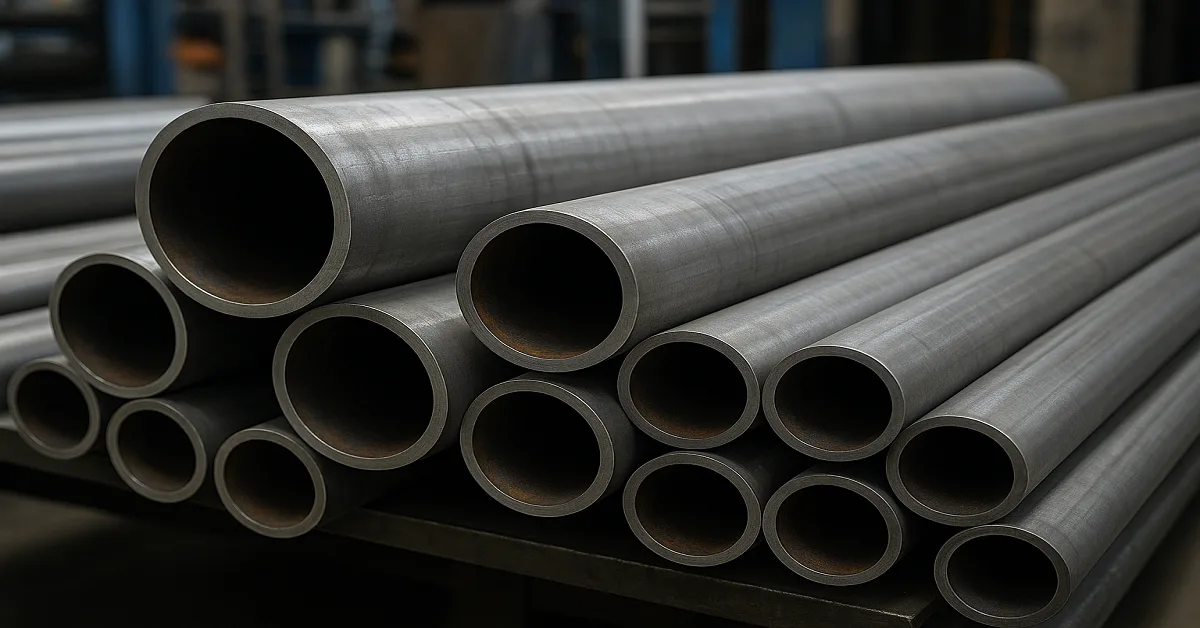
Caption: Various steel pipes stacked in a warehouse, showing differences in diameter and thickness.
Alt Text: Close-up image of industrial steel pipes in different sizes and finishes arranged horizontally.
These visual distinctions help buyers recognize pipe types, from small ½ inch pipes to large 8-inch industrial tubes.
Weight Per Meter Table (Expanded Reference)
| Nominal Bore | OD (mm) | Wall Thickness (mm) | Weight (kg/m) |
|---|---|---|---|
| ½” | 21.3 | 2.6 | 1.27 |
| ¾” | 26.9 | 2.9 | 1.67 |
| 1” | 33.7 | 3.2 | 2.74 |
| 1¼” | 42.4 | 3.2 | 3.49 |
| 1½” | 48.3 | 3.2 | 3.91 |
| 2” | 60.3 | 3.6 | 5.44 |
| 2½” | 76.1 | 3.6 | 6.93 |
| 3” | 88.9 | 4.0 | 9.62 |
| 4” | 114.3 | 4.5 | 13.95 |
| 6” | 168.3 | 5.0 | 24.55 |
| 8” | 219.1 | 6.3 | 37.74 |
| 10” | 273.1 | 7.1 | 56.45 |
| 12” | 323.9 | 8.0 | 76.00 |
Frequently Asked Questions (FAQ)
Q1. What is the formula for steel pipe weight?
The formula is (Outer Diameter – Wall Thickness) × Wall Thickness × 0.02466.
Q2. What is the density of steel used in this formula?
The density used is approximately 7850 kg/m³ for mild and carbon steel.
Q3. How can I calculate total weight for a 6-meter pipe?
Multiply the weight per meter by 6. Example: 5 kg/m × 6 m = 30 kg.
Q4. Are stainless steel pipes heavier than mild steel pipes?
Yes, slightly. Stainless steel has a higher density of about 7930 kg/m³.
Q5. What standards are followed for pipe sizes in India?
IS 1239 and IS 3589 standards define dimensions, weight, and manufacturing tolerances.
Q6. How can I check pipe weight online?
Many industrial suppliers offer pipe weight calculators where you can input diameter and thickness.
Q7. What is the difference between Schedule 40 and Schedule 80 pipes?
Schedule 80 pipes have thicker walls and thus weigh more than Schedule 40 pipes of the same diameter.
Summary
Steel pipe weight is a fundamental parameter in construction, manufacturing, and industrial systems. It influences project cost, design safety, and logistics.
By applying the formula (OD – T) × T × 0.02466, anyone can estimate the pipe’s weight quickly and accurately.
For practical use, engineers rely on standardized tables from IS 1239 or ASTM, ensuring consistent results across projects.
Whether you are purchasing, designing, or transporting pipes, understanding weight data helps ensure safety, accuracy, and efficiency.
Real-World Example Quote
According to the Indian Standard IS 1239 (Part 1): 2004, “The mass of steel tubes shall be determined by the nominal bore and class of tube, ensuring weight tolerance of ±7.5% for each length.”
This statement reinforces that real-world pipe weight can vary slightly depending on manufacturing precision and coating type.