
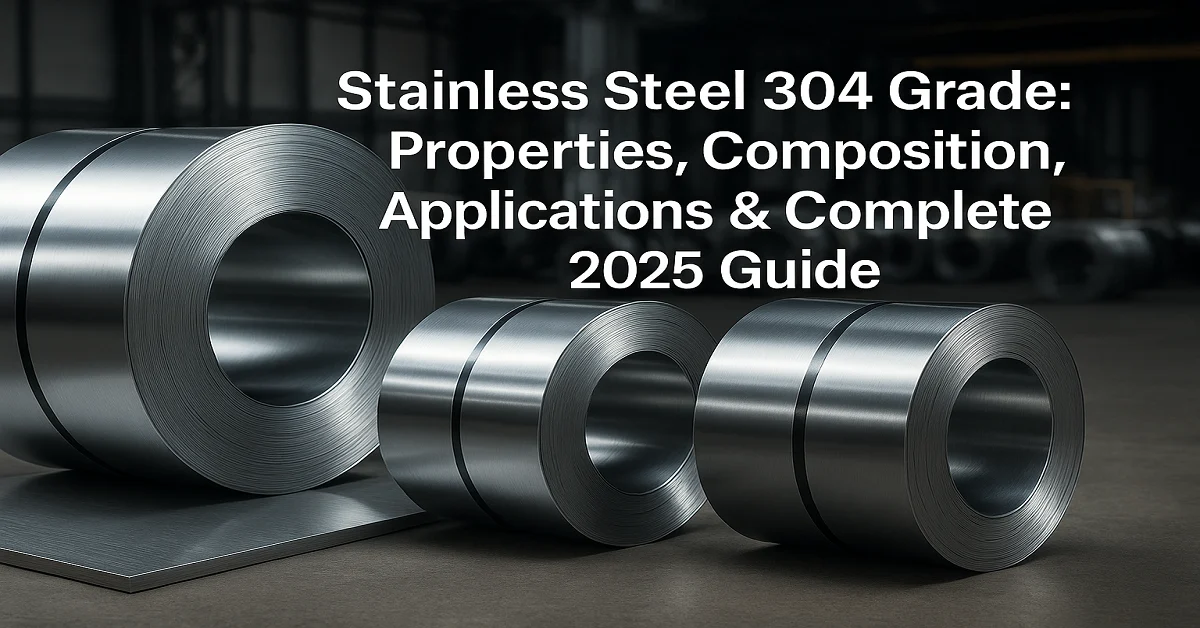
The Global Standard of Stainless Steel
When people talk about stainless steel, they’re often referring to Stainless Steel 304 Grade — the most widely used and versatile alloy in the world.
Known for its excellent corrosion resistance, high strength, and easy formability, SS 304 is found everywhere — from kitchen sinks to industrial piping systems. As of 2025, it remains the preferred choice across construction, food processing, chemical, and automotive industries.
But what makes 304 stainless steel so special? Let’s dive deep into its composition, properties, and real-world applications.
What Is Stainless Steel 304 Grade?
Stainless Steel 304 belongs to the austenitic family of stainless steels — non-magnetic, highly formable, and exceptionally corrosion-resistant.
It contains 18% chromium (Cr) and 8% nickel (Ni) — which is why it’s often called 18/8 stainless steel. This balanced chemistry gives it an excellent combination of durability and cost-effectiveness.
“304 stainless steel is the industry’s gold standard — strong, weldable, and resistant to most environments,” notes the World Stainless Association in its 2024 report.
Chemical Composition of 304 Stainless Steel
| Element | Percentage (%) | Function |
|---|---|---|
| Chromium (Cr) | 17.5 – 19.5 | Improves corrosion resistance |
| Nickel (Ni) | 8.0 – 10.5 | Enhances strength & ductility |
| Carbon (C) | ≤ 0.08 | Provides hardness |
| Manganese (Mn) | ≤ 2.0 | Improves toughness |
| Silicon (Si) | ≤ 1.0 | Strengthens structure |
| Phosphorus (P) | ≤ 0.045 | Minor alloying element |
| Sulphur (S) | ≤ 0.03 | Improves machinability |
| Iron (Fe) | Balance | Base metal |
Mechanical Properties
| Property | Typical Value |
|---|---|
| Density | 8.0 g/cm³ |
| Tensile Strength | 515 – 750 MPa |
| Yield Strength | 205 MPa |
| Elongation | 40% minimum |
| Hardness (Rockwell B) | 70 – 90 HRB |
| Melting Point | 1400°C – 1450°C |
These numbers make 304 suitable for both high-strength and high-temperature applications.
Key Features and Benefits of SS 304
- Excellent Corrosion Resistance
With 18% chromium, SS 304 naturally forms a protective oxide film, preventing rust in moist or humid environments. - Non-Magnetic and Hygienic
Perfect for food processing and hospital use where cleanliness is critical. - High Formability and Weldability
It can be rolled, bent, welded, and machined without losing mechanical integrity. - Heat Resistance
Performs well up to 870°C in intermittent service and 925°C in continuous service. - Attractive Finish
Can be mirror-polished or brushed for architectural or decorative purposes. - Cost-Effective
More affordable than 316-grade while maintaining strong corrosion resistance.
Common Applications of Stainless Steel 304
- Architecture & Construction
Used in railings, facades, handrails, and structural supports. - Food Processing & Kitchenware
Ideal for sinks, countertops, cutlery, and tanks due to its hygienic surface. - Chemical Industry
Used in storage tanks and piping systems that handle mild acids and alkaline solutions. - Automotive Industry
Found in exhaust systems, trims, and heat shields. - Medical Equipment
Chosen for surgical tools and hospital furniture due to its non-reactive nature. - Energy & Engineering
Used in boilers, heat exchangers, and pressure vessels.
304 vs 316 Stainless Steel – The Major Difference
| Property | SS 304 | SS 316 |
|---|---|---|
| Composition | 18% Cr, 8% Ni | 16% Cr, 10% Ni, 2% Mo |
| Corrosion Resistance | Excellent | Superior (especially in chlorides) |
| Cost | Lower | Higher |
| Applications | Kitchen, construction, food industry | Marine, chemical, coastal environments |
Conclusion:
If your application involves saltwater or chemical exposure, 316 is better. Otherwise, 304 is the best all-around choice for cost and performance.
Different Forms of SS 304 Available
- SS 304 Sheets and Plates – for fabrication and construction.
- SS 304 Pipes and Tubes – for fluid transport and structural use.
- SS 304 Rods and Bars – for machining and forging components.
- SS 304 Coils – used in heat exchangers and flexible tubing.
- SS 304 Angles and Channels – used in frames and supports.
“Over 50% of stainless steel products sold globally are made from 304 grade,” states International Stainless Market Outlook 2025.
Heat Treatment and Fabrication Tips
- Annealing: Heat at 1050°C – 1100°C followed by rapid cooling improves ductility.
- Welding: Can be welded using MIG or TIG processes without filler metal.
- Machining: Requires sharp tools and moderate speeds.
- Pickling: Recommended after fabrication to restore corrosion resistance.
Limitations of 304 Stainless Steel
- Not Suitable for Chloride Environments
Prone to pitting corrosion in saline or coastal areas. - Work Hardening
Becomes harder during cold working, requiring intermediate annealing. - Less Resistant to Acids
Not ideal for strong acid handling or high-temperature acid processing. - No Magnetic Properties
Can’t be magnetized unless cold worked.
Stainless Steel 304L Variant
304L is the low-carbon version of 304 (C ≤ 0.03%), designed for improved weldability and reduced risk of carbide precipitation.
Applications:
- Chemical processing
- Pressure vessels
- Structural welding
Note: 304 and 304L are often interchangeable in non-critical applications.
Real-World Case Study
In 2024, Jindal Stainless supplied over 60,000 tonnes of SS 304 coils for India’s railway modernization program. The material was chosen for its long life, aesthetic appeal, and corrosion resistance — saving an estimated ₹120 crore annually in maintenance costs.
Stainless Steel 304 vs Mild Steel
| Parameter | Stainless Steel 304 | Mild Steel |
|---|---|---|
| Composition | Cr-Ni Alloy | Carbon Iron |
| Corrosion Resistance | Excellent | Poor |
| Cost | Higher | Lower |
| Strength | High | Moderate |
| Maintenance | Minimal | High |
| Longevity | 30–50 years | 10–15 years |
Global Market Overview (2025)
According to MarketWatch 2025, global demand for stainless steel 304 is expected to grow by 5.7% annually. India remains a top producer and consumer, with exports increasing by 12% YoY.
The automotive and construction sectors are driving over 60% of demand, especially in Asia-Pacific regions.
Expert Opinion
“Stainless Steel 304 is the workhorse of modern industry — adaptable, sustainable, and infinitely recyclable,” says Ramesh Agarwal, Chairman of the Indian Stainless Steel Development Association (ISSDA).
Environmental Impact & Sustainability
- 304 stainless steel is 100% recyclable.
- Manufacturing uses up to 60% recycled material.
- Long service life reduces waste and carbon footprint.
This makes it an ideal material for green building certifications like LEED and IGBC.
Summary
Stainless Steel 304 Grade remains the most reliable and cost-efficient material for countless applications. With superior corrosion resistance, weldability, and strength, it serves as the foundation of industries ranging from food and construction to energy and transportation.
Whether you’re a manufacturer, engineer, or designer — 304 stainless steel provides unmatched performance and sustainability for the modern age.
Frequently Asked Questions (FAQ)
1. What is stainless steel 304 grade made of?
It’s an austenitic alloy containing 18% chromium and 8% nickel, giving it strength and corrosion resistance.
2. What is the difference between 304 and 304L?
304L has lower carbon content, making it more suitable for welding applications.
3. Can 304 stainless steel rust?
Under normal conditions, no — but it can show surface discoloration in high-chloride environments.
4. Is 304 food-grade stainless steel?
Yes. 304 is the most commonly used food-safe alloy worldwide.
5. Can 304 stainless steel be used outdoors?
Yes, it performs well in urban and mild coastal environments, though 316 is better for marine exposure.
6. What is the lifespan of SS 304?
Typically 30 to 50 years depending on environment and maintenance.
7. Is stainless steel 304 magnetic?
No, it’s generally non-magnetic, though light magnetism may develop after cold working.