
Introduction
Pipe fittings are important parts used in every piping system. Whether it is a factory, building, water line, or a workshop, it help connect pipes, change direction, and manage the flow of liquids or gases. In this easy guide, you will learn what they are, their types, materials, and where they are used.
Many trusted suppliers like Udhhyog also provide high-quality fittings for industrial and commercial needs.
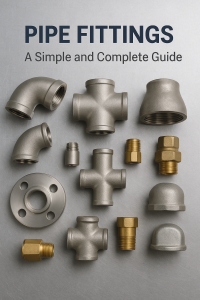
What Are Pipe Fittings?
Pipe fittings are components that connect one pipe to another. They help you:
-
Join two pipes
-
Change the direction of flow
-
Reduce or increase pipe size
-
Close the pipe end
-
Branch the flow into different lines
Pipe fittings make any piping system safe, strong, and leak-proof.
Why Pipe Fittings Are Important
Pipe fittings play a major role in every system:
-
They help create complex pipe layouts
-
They support pressure and flow control
-
They make installation and maintenance easy
-
They ensure safety and prevent leaks
Industrial suppliers like Udhhyog offer fittings designed to handle tough working conditions and long-term use.
Types of Pipe Fittings
Below are the most common uses in industries, plumbing, and construction:
1. Elbows
Elbows help change the direction of the pipe.
Common angles: 90° and 45°
Used in: water supply, industrial pipelines, and plumbing.
2. Tee
A tee fitting divides the flow or joins two lines.
Types:
-
Equal tee
-
Reducing tee
3. Reducers
Reducers connect pipes of different sizes.
Types:
-
Concentric reducer
-
Eccentric reducer
Udhhyog supplies both types of reducers for different industrial uses.
4. Couplings
Couplings join two pipes permanently.
Types:
-
Full coupling
-
Half coupling
-
Reducing coupling
5. Union
Unions also join pipes, but they can be opened anytime.
Useful in systems that require regular maintenance.
6. Nipples
A small piece used to connect two fittings or a pipe and a fitting.
7. Cap and Plug
Used to close the end of a pipe.
-
Caps cover the outside
-
Plugs are inserted inside
8. Cross
A cross has four openings and distributes flow in multiple directions.
9. Flanges
Flanges use bolts to join pipes.
Common in high-pressure or high-temperature pipelines.
Udhhyog also deals in industrial-grade flanges used in mechanical and chemical plants.
10. Olets
Used when a new outlet or branch is needed.
Examples:
-
Weldolet
-
Sockolet
-
Thredolet
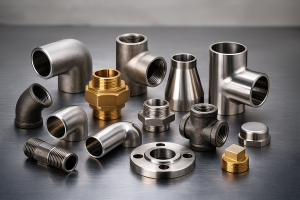
Materials Used in Pipe Fittings
| Material | Features | Common Use |
|---|---|---|
| Stainless Steel | Rust-free, long life | Chemical, pharma, food industries |
| Carbon Steel | Very strong | Oil, gas, industrial lines |
| Copper | Corrosion-resistant | Plumbing, HVAC |
| PVC / CPVC / UPVC | Lightweight, economical | Water systems, residential uses |
| Brass | Durable and corrosion-resistant | Gas lines, valves |
| Cast Iron | Heavy-duty | Drainage & sewer systems |
Udhhyog supplies pipe fittings in multiple materials depending on customer needs.
Where Pipe Fittings Are Used
used in:
-
Industrial plants
-
Water and plumbing systems
-
Fire protection lines
-
Chemical and food industries
-
HVAC systems
-
Irrigation projects
Basically, wherever pipes are installed are required.
How to Choose the Right Pipe Fitting
Before selecting check:
-
Material requirement
-
Correct pipe size
-
Pressure and temperature rating
-
Connection type (threaded, welded, flanged)
-
Industry standards (ASME/ASTM)
-
Maintenance needs
Reliable suppliers like Udhhyog provide fittings that meet industrial standards and quality checks.
Benefits of Using Quality Pipe Fittings
-
Smooth flow with less pressure drop
-
Long system life
-
Fewer leaks
-
Easy maintenance
-
Higher safety
Conclusion
Pipe fittings are essential for building safe, strong, and efficient pipelines. They help join, control, and protect pipelines in every industry. By understanding the types and uses you can choose the right components for your project.
Brands like Udhhyog make it easier by supplying durable and reliable for industrial, commercial, and residential applications.