
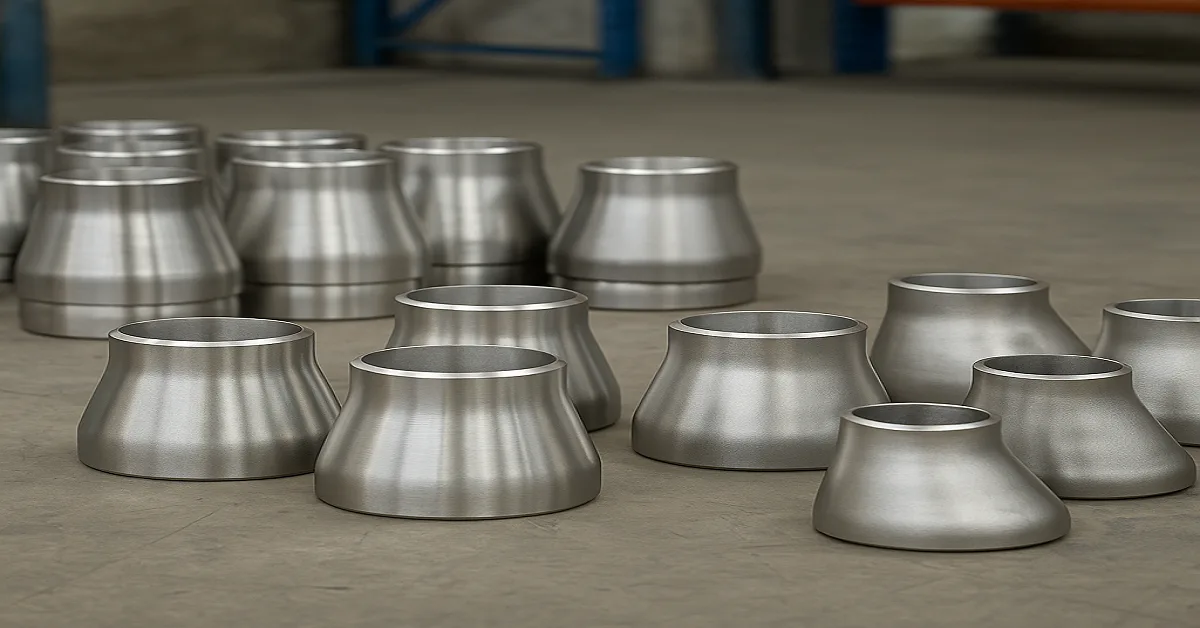
Stainless Steel Pipe Reducer – Complete 2025 Technical Guide
In the world of piping and fluid transfer systems, every fitting plays a vital role in ensuring efficiency, durability, and leak-proof operation. One of the most important fittings used in stainless steel pipelines is the pipe reducer.
A stainless steel pipe reducer is used to connect two pipes of different diameters while maintaining a steady flow and minimizing turbulence. This comprehensive 2025 guide explains the types, materials, dimensions, and applications of stainless steel reducers, along with real-world examples, pricing, and FAQs.
What Is a Stainless Steel Pipe Reducer?
A pipe reducer is a component that reduces the size of a pipe from a larger diameter to a smaller one. It allows for a smooth flow transition between pipes of varying sizes, preventing pressure loss and flow disturbance.
Stainless steel reducers are made from corrosion-resistant alloys that provide high strength and excellent performance under pressure and temperature variations.
Function and Purpose
-
Flow Adjustment:
They help control fluid velocity when changing from a larger to a smaller pipe diameter. -
System Efficiency:
Maintains hydraulic balance and ensures consistent pressure in pipelines. -
Connection Flexibility:
Enables integration between different pipe sizes during repairs or expansions. -
Corrosion Protection:
Stainless steel prevents rust formation and ensures long service life in chemical, marine, and water systems.
Types of Stainless Steel Pipe Reducers
There are primarily two types of stainless steel pipe reducers used in industries:
1. Concentric Reducer
-
The most common type.
-
The centerline of both ends (larger and smaller) remains in the same axis.
-
Ideal for vertical piping systems or in-line flow applications.
-
Commonly used in pumps, pipelines, and tanks.
Example: Connecting a 4-inch pipe to a 2-inch pipe in a vertical line without disturbing the alignment.
2. Eccentric Reducer
-
The centerlines of the inlet and outlet are offset.
-
Prevents accumulation of air or gas pockets in horizontal lines.
-
Commonly used in suction lines and horizontal pipelines where drainage is critical.
Example: Used at pump suction lines to avoid cavitation by maintaining the liquid level.
Standards and Specifications
Stainless steel reducers are manufactured according to various international standards to ensure dimensional accuracy and pressure compatibility.
| Standard | Description |
|---|---|
| ASME B16.9 | Factory-made wrought steel butt-weld fittings |
| ASTM A403 | Standard specification for wrought austenitic stainless steel fittings |
| DIN 2616 | European standard for butt weld pipe reducers |
| MSS-SP 43 | Stainless steel butt-weld fittings for low-pressure use |
Material Grades Used in Stainless Steel Reducers
The choice of material depends on pressure, temperature, and environmental conditions.
| Grade | Composition Highlights | Applications |
|---|---|---|
| 304 / 304L | 18% Chromium, 8% Nickel | General piping, water, and food processing |
| 316 / 316L | 16% Chromium, 10% Nickel, 2% Molybdenum | Marine and chemical industries |
| 321 | Titanium-stabilized | High-temperature service |
| 904L | High nickel, copper, molybdenum | Acidic and chloride environments |
Available Dimensions of Stainless Steel Pipe Reducers
Reducers are classified based on the Nominal Pipe Size (NPS) and wall thickness (schedule).
Below are common dimensions based on ASME B16.9 standard.
| Large End (mm) | Small End (mm) | Length (mm) |
|---|---|---|
| 48.3 | 33.7 | 76 |
| 60.3 | 48.3 | 89 |
| 76.1 | 60.3 | 102 |
| 88.9 | 76.1 | 114 |
| 114.3 | 88.9 | 140 |
| 168.3 | 114.3 | 165 |
| 219.1 | 168.3 | 191 |
| 273.1 | 219.1 | 203 |
These are approximate dimensions for standard concentric reducers.
Manufacturing Methods
-
Seamless Reducers:
Produced from seamless pipes through hot or cold forming. Used for high-pressure systems. -
Welded Reducers:
Made from welded pipes or plates; cost-effective for low to medium pressure. -
Butt Weld Reducers:
Designed for permanent joints; widely used in chemical and oil industries. -
Socket Weld and Threaded Reducers:
Used for small-bore pipes and where frequent disassembly is required.
Surface Finishes Available
-
Mill Finish: Standard, slightly rough surface straight from production.
-
Pickled Finish: Acid-cleaned to remove oxides and scales.
-
Polished (Mirror Finish): Decorative or architectural use.
-
Sand Blasted / Matte: Non-reflective finish for industrial environments.
Applications of Stainless Steel Pipe Reducers
-
Oil and Gas Pipelines: To connect different pipe diameters in refinery systems.
-
Chemical Processing Plants: For pressure regulation and corrosion resistance.
-
Water Treatment Plants: Used in stainless systems for potable and wastewater.
-
Food and Beverage Industry: Ensures hygiene and easy cleaning.
-
HVAC and Fire Protection: Connects pipes in temperature-controlled systems.
-
Marine and Offshore Structures: Corrosion-proof and strong under saline conditions.
Advantages of Stainless Steel Pipe Reducers
-
High Strength and Durability
Withstands high pressure and temperature. -
Corrosion Resistance
Ideal for chemical and marine environments. -
Low Maintenance
Stainless steel requires minimal upkeep and lasts decades. -
Leak-Free Welding Capability
Ensures long-term safety and reliability. -
Aesthetic Appearance
Mirror finish versions are often used in visible installations.
Real-World Example
In 2024, a major refinery project in Gujarat used over 5,000 stainless steel reducers (304L and 316L grades) to connect high-pressure steam and chemical lines.
By switching from carbon steel to stainless steel reducers, maintenance downtime decreased by 38%, and pipe life increased by over 12 years, proving stainless steel’s superior performance.
Installation Tips
-
Always align reducers properly to avoid vibration or cavitation.
-
Use concentric reducers for vertical systems and eccentric reducers for horizontal lines.
-
Inspect weld joints for porosity or cracks after installation.
-
Apply proper torque and sealing in threaded versions.
Typical Pricing of Stainless Steel Pipe Reducers (2025)
| Size (Large x Small) | Grade | Type | Price (₹/Piece) |
|---|---|---|---|
| 2” x 1” | 304 | Concentric | ₹180–₹250 |
| 3” x 2” | 304 | Concentric | ₹250–₹350 |
| 4” x 2” | 316 | Concentric | ₹400–₹550 |
| 6” x 4” | 316L | Eccentric | ₹650–₹850 |
| 8” x 6” | 304L | Concentric | ₹900–₹1100 |
Prices vary depending on wall thickness, finish, and manufacturer.
Top Manufacturers and Suppliers in India
-
Jindal Stainless Ltd. – Leading producer of stainless steel pipe fittings.
-
Venus Pipes & Tubes Ltd. (Gujarat) – Specialized in reducers, elbows, and tees.
-
Ratnamani Metals & Tubes Ltd. (Ahmedabad) – Large exporter of stainless fittings.
-
Nexus Alloys & Steels (Mumbai) – Supplier of 304, 316L, and 904L reducers.
-
Suraj Limited (GIDC, Gujarat) – ISO-certified manufacturer of seamless reducers.
Summary
A stainless steel pipe reducer is an essential fitting that ensures a smooth flow between pipes of varying diameters. Available in concentric and eccentric types, these fittings are manufactured to ASME B16.9 and ASTM A403 standards.
Their durability, corrosion resistance, and precise design make them indispensable in oil, gas, chemical, and water industries. Stainless steel reducers may cost more than carbon steel ones, but their longer life and reduced maintenance make them a cost-effective choice in the long run.
Frequently Asked Questions (FAQ)
Q1. What is a stainless steel pipe reducer used for?
It connects two pipes of different diameters to maintain steady flow and reduce turbulence.
Q2. What is the difference between concentric and eccentric reducers?
Concentric reducers have a common centerline, while eccentric reducers are offset to prevent air pockets in horizontal systems.
Q3. Which standard covers stainless steel reducers?
ASME B16.9 and ASTM A403 cover the dimensions and material properties for stainless steel reducers.
Q4. What grades are commonly used for reducers?
Grades 304, 316, 321, and 904L are most common, depending on the environment.
Q5. Are reducers available in seamless form?
Yes, seamless reducers are used in high-pressure or high-temperature systems.
Q6. What is the average lifespan of stainless steel reducers?
Depending on the grade and environment, they can last between 20 to 40 years.