
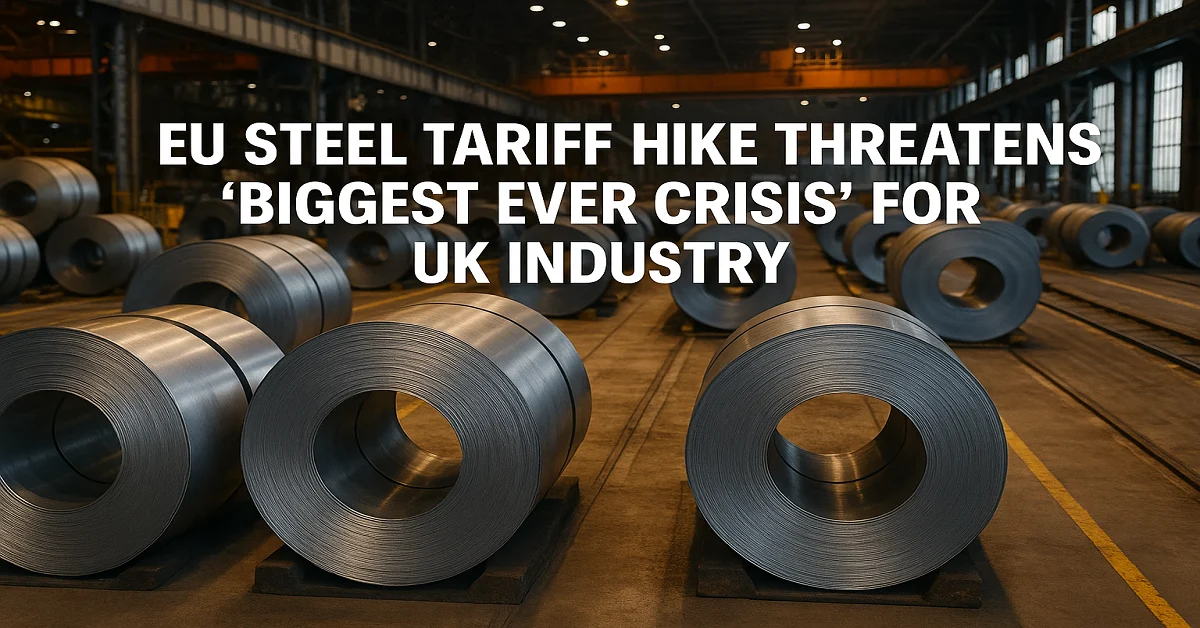
A Looming Crisis for the UK Steel Sector
The European Union’s proposed 50% tariff hike on steel imports has sent shockwaves through the UK steel industry. Trade bodies and manufacturers warn that this could be the “biggest ever crisis” for a sector already struggling with energy costs, reduced demand, and global overcapacity.
The move could push up export costs, trigger job losses, and damage Britain’s manufacturing base — unless urgent diplomatic action is taken. But what’s behind this sudden tariff escalation, and what does it mean for the UK’s economic future?
What Exactly Is the EU Steel Tariff Hike?
In late 2025, the European Commission proposed reducing its tariff-free quota for steel imports by nearly half — from approximately 33 million tonnes to 18.3 million tonnes. Any imports exceeding that quota would face a massive 50% tariff, up from the current safeguard level of around 25%.
This means UK steelmakers, who export nearly 78% of their steel to the EU, would be hit directly. The policy is part of the EU’s attempt to protect its domestic producers from cheaper imports, especially from Asia.
“This is an existential threat to UK steel — it could wipe out export markets that took decades to build,” said Gareth Stace, Director General of UK Steel, in an interview with The Guardian (Oct 2025).
Why Is the EU Doing This?
The EU argues that global steel overproduction — particularly from China and Turkey — has flooded the market, depressing prices and hurting EU producers.
Officials say the tariffs are designed to:
- Protect EU jobs and investment in the steel industry.
- Support decarbonization efforts by making local production more viable.
- Ensure fair competition against state-subsidized steel.
According to an EU Commission report (2025), imported steel has been undercutting EU-produced steel by as much as 15–20%, making long-term sustainability impossible without protective measures.
Why the UK Is at High Risk
The UK steel sector exports around 1.9 million tonnes of steel annually to EU nations — roughly four-fifths of its total exports. Losing tariff-free access would make British steel uncompetitive overnight.
British producers already face challenges like high energy costs, carbon levies, and a smaller domestic market. The tariff would likely force some mills to scale down or even shut.
“It’s not an exaggeration to call this catastrophic. For some plants, this could mean closure within months of implementation,” warned the Community Trade Union in a 2025 statement.
How Big Could the Impact Be?
The UK steel industry supports around 33,000 direct jobs and over 75,000 indirect jobs in related manufacturing and logistics. Industry analysts estimate that 5,000–7,000 jobs could be lost within the first year if tariffs take effect.
Economists predict a potential £2 billion annual loss in trade revenue and a drop in domestic production by up to 30%.
The sectors most affected include:
- Automotive – 40% of UK steel output goes into car manufacturing.
- Construction – dependent on affordable steel beams and tubing.
- Energy infrastructure – pipelines, wind towers, and machinery.
Government Response
The UK government has called the EU’s proposal “deeply concerning” and is seeking urgent negotiations for a tariff exemption or quota carve-out for British steel.
Trade Minister Kemi Badenoch told The Financial Times that the UK is “exploring all diplomatic and legal avenues to protect its national interests.”
Officials are also considering:
- Expanding domestic decarbonization grants to offset competitiveness loss.
- Forming a joint steel council with the EU to prevent a full trade dispute.
- Retaliatory tariffs if no resolution is found.
So far, however, the EU has shown little sign of softening its position.
EU’s Defense of the Tariff
From the EU’s perspective, this isn’t an anti-UK move. EU Trade Commissioner Valdis Dombrovskis emphasized that “all third-country exporters will be treated equally.”
The EU says it’s focusing on internal sustainability and carbon neutrality goals under its “Green Steel” plan. It believes the new tariff will help local steelmakers invest in hydrogen-based production and reduce carbon emissions by 30% by 2030.
In other words, the policy is being positioned as environmental protection, not trade protectionism — though critics say it’s both.
Global Reactions
Other nations have also expressed concern.
- Turkey and India criticized the tariff as “unfair protectionism.”
- The United States remains cautious, fearing similar moves could affect transatlantic trade.
- China called the EU policy “economic nationalism in disguise.”
Analysts warn that escalating tariffs globally could lead to a new steel trade war, similar to the one sparked by U.S. tariffs under Donald Trump in 2018.
What UK Steelmakers Are Saying
UK companies such as Tata Steel, British Steel, and Liberty Steel are already under pressure from high operating costs. These firms warn that the EU’s tariff hike could “wipe out profitability entirely.”
Tata Steel’s Port Talbot plant in Wales, one of the largest in Europe, exports nearly 60% of its product to the EU. A 50% tariff would price it out of the market.
“This is our biggest challenge in a generation. Without action, the UK steel industry could collapse faster than anyone expects,” said Jon Ferriman, managing director of Tata Steel UK.
Potential UK Countermeasures
The UK has several limited options to soften the blow:
- Negotiate exemptions or special quotas within the EU framework.
- Subsidize domestic steel to offset export losses.
- Pivot to new markets, such as the U.S., Asia, or Africa — though this requires time and new trade agreements.
- Invest in green steel to make products more competitive under global sustainability standards.
Experts argue that the UK should use this crisis to accelerate modernization and reduce reliance on EU markets.
Real-World Impact Example
In 2024, when a smaller quota reduction was trialed, exports from the UK to Germany fell by 18% in six months, costing approximately £240 million in revenue.
If the 2026 tariffs proceed, industry forecasts suggest a 50–60% fall in exports to EU countries — an unprecedented drop in the modern era.
Industry Voices
UK Steel Association: “The EU’s proposal could be the single most damaging trade measure since Brexit for British manufacturing.”
Make UK (Manufacturing Confederation): “We need cooperation, not confrontation. Tariff wars will raise costs for everyone.”
TUC (Trade Union Congress): “Steel jobs are the backbone of many communities. Without urgent government action, entire towns could suffer.”
Environmental Context
Ironically, this crisis hits just as the UK and EU are both trying to push the net-zero industrial transition.
The UK is investing £2.5 billion in green steel projects, while the EU’s “Green Deal Industrial Plan” allocates €5 billion for cleaner production.
However, if UK exports collapse, the financial base for sustainability projects will shrink — delaying carbon-neutral steel goals.
Economic Analysts’ Perspective
According to Oxford Economics (2025), the tariff could shave 0.2% off UK GDP annually if left unresolved.
PwC’s 2025 trade report predicts a £6.5 billion cumulative impact over five years.
In contrast, the EU might see only marginal benefits — stabilizing prices but raising costs for its manufacturers who rely on imported semi-finished steel.
Public Sentiment and Political Fallout
The issue has sparked fierce debate in Parliament. Opposition leaders accuse the government of being “asleep at the wheel” over trade negotiations.
Meanwhile, in steelmaking regions like Wales, Yorkshire, and Scunthorpe, workers fear another wave of layoffs.
Social media movements under hashtags #SaveUKSteel and #TradeFairnessNow are gaining traction, echoing calls for a “national steel strategy.”
Summary
The EU steel tariff hike represents more than a policy shift — it’s a potential economic earthquake for the UK’s steel industry. With exports, jobs, and national infrastructure at stake, this could truly be the biggest crisis in decades for British manufacturing.
Whether the UK negotiates a solution or faces a prolonged trade standoff, one thing is clear: the future of UK steel now depends as much on diplomacy as on molten metal.
Frequently Asked Questions (FAQ)
1. What is the EU steel tariff increase?
The EU plans to impose a 50% tariff on steel imports exceeding new quota limits, down nearly 50% from current levels.
2. Why does this affect the UK so severely?
Because around 78% of UK steel exports go to the EU, any new trade barrier directly affects revenue and jobs.
3. When will the tariffs take effect?
Implementation is expected in early 2026, pending approval from the European Parliament and member states.
4. How is the UK government responding?
The government is seeking exemptions and considering domestic subsidies to protect local producers.
5. What can steel companies do to adapt?
Invest in cleaner production, find new export markets, and collaborate with trade groups for lobbying efforts.
6. Will consumers be affected?
Yes — higher steel prices could increase costs for cars, buildings, and appliances.