
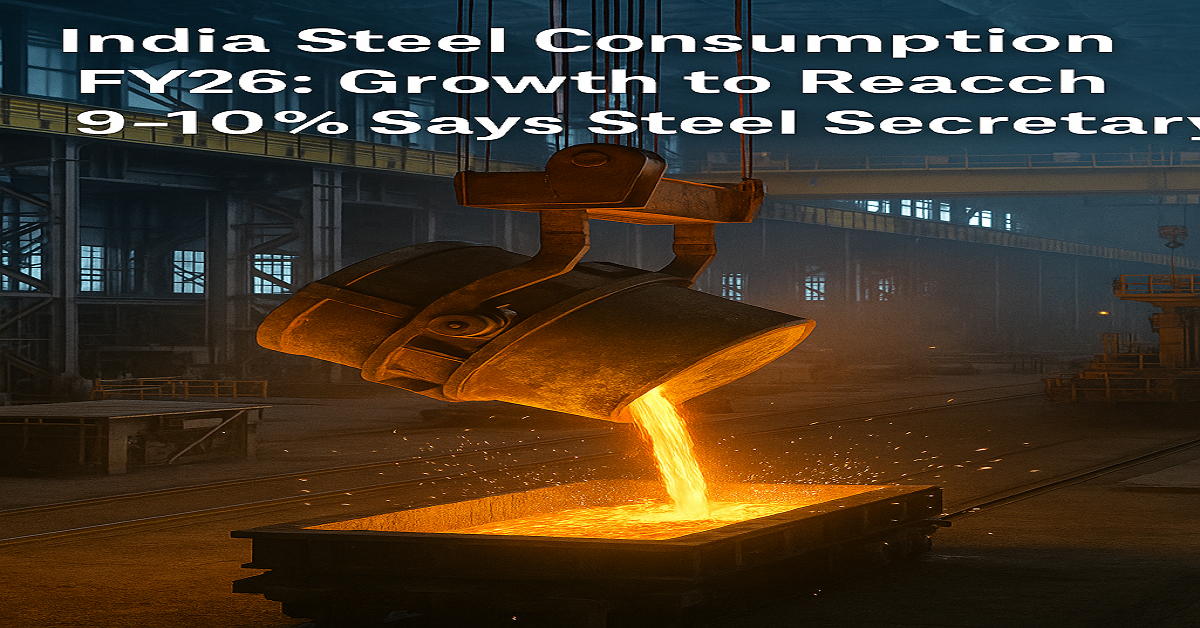
India’s steel consumption in FY26 is projected to grow by 9–10%, according to the Union Steel Secretary. This growth outlook comes at a time when global steel demand is slowing, highlighting India’s role as a major driver of the global steel industry.
The expected rise is linked to strong government infrastructure spending, private investments in construction, rising automobile production, and the renewable energy push. If achieved, India could cross 145–150 million tonnes of steel consumption in FY26.
Introduction: Steel Consumption Outlook for India in FY26
India’s steel consumption FY26 is expected to expand by 9–10%, reaffirming the country’s position as the second-largest steel consumer in the world. This estimate comes from the Steel Secretary, who underlined India’s resilience despite global headwinds.
The announcement places India in a unique position where domestic drivers like infrastructure, housing, and automobiles will continue to fuel demand, even as global consumption remains subdued.
Current Consumption Trends
- In FY25, India’s steel consumption grew by 8.5%, reaching approximately 135 million tonnes.
- Demand from the construction sector accounted for nearly 65% of consumption.
- The automobile sector saw an 11% rise in steel usage, with EV manufacturing contributing.
- Rural housing projects also added significantly to demand growth.
Why Steel Consumption Will Rise in FY26
Infrastructure Push
The government’s ₹11 lakh crore capital expenditure budget for FY26 is a major driver. Projects include roads, railways, metros, and urban infrastructure.
Real Estate Revival
Housing demand in Tier-1 and Tier-2 cities is recovering strongly, with real estate registrations in Mumbai hitting a 10-year high.
Automobile and EV Growth
Passenger vehicle sales crossed 5 million units in FY25, and steel demand from EV battery and component plants will accelerate further in FY26.
Renewable Energy Expansion
India’s target of 500 GW of renewable energy capacity by 2030 ensures steady steel demand for solar, wind, and transmission projects.
Challenges Facing the Steel Sector
- High Input Costs: Coking coal imports averaged $315/tonne in FY25 and remain elevated.
- Global Weakness: Demand from Europe and ASEAN markets remains sluggish.
- Carbon Neutrality Goals: Indian mills must balance growth with sustainability targets for 2070 net-zero commitments.
Quotes from Industry Experts
- “India will be the bright spot for global steel demand in FY26. Infrastructure and real estate are driving robust growth.” — CRISIL Research
- “Despite high input costs, steelmakers in India are better positioned due to strong domestic demand.” — CARE Ratings
Global Context
While India’s steel consumption is set to expand, China’s steel demand is plateauing. This provides India with a chance to become the world’s primary growth engine for steel demand.
The World Steel Association projects global steel demand to rise only by 1.5% in 2025, compared to India’s 9–10% growth outlook.
Outbound link suggestion: World Steel Association
Price and Valuation Impact
Increased domestic demand will likely:
- Support stable steel prices in the range of ₹55,000–₹60,000 per tonne.
- Improve earnings visibility for listed steel majors such as Tata Steel, JSW Steel, and SAIL.
- Attract further foreign institutional investment (FII) into the metals and mining sector.
Internal link suggestion: Read our article: Valuations Reflect Upside for Listed Steel Majors Despite Weak Q2
Frequently Asked Questions (FAQ)
Q1: What is India’s steel consumption forecast for FY26?
The Steel Secretary projects 9–10% growth, reaching around 145–150 million tonnes.
Q2: What sectors will drive this growth?
Infrastructure, real estate, automobiles (especially EVs), and renewable energy.
Q3: How does India compare globally?
While global demand is expected to rise only 1.5%, India’s consumption will grow nearly 10%.
Q4: What risks exist for the steel sector?
High input costs, global slowdown, and environmental compliance requirements.
Q5: How will this affect steel prices?
Strong demand should keep domestic prices stable and valuations attractive for listed companies.
Conclusion
India’s projected 9–10% growth in steel consumption for FY26 highlights its strategic role in the global metals market. Despite challenges like high input costs and global weakness, the domestic outlook remains strong, driven by government investments, housing revival, automobile growth, and renewable energy projects.
If achieved, India’s steel consumption will cross 145 million tonnes, setting new records and further strengthening its position as a global steel powerhouse.